Cable Manufacturing Machines: Types, Costs & Suppliers
Choosing cable manufacturing machines requires balancing production speed.
Selecting the wrong wire and cable production line creates bottlenecks, high scrap rates, and unnecessary capital expenditure.
Understanding machine categories, capacity trade-offs, and supplier service standards lets facility managers invest in reliable equipment.
Core Types of Cable Manufacturing Machines
A complete cable plant relies on specialized equipment at each stage of conductor preparation, insulation, and assembly.
Wire Drawing Machines
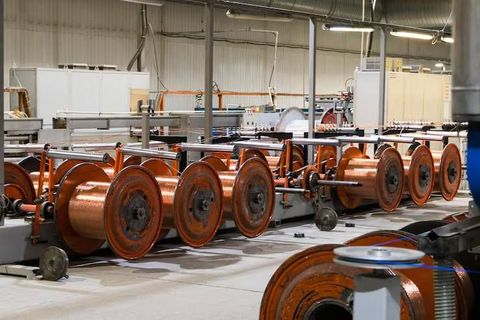
Wire drawing machines pull copper or aluminum rods through sequential tungsten carbide or diamond dies to reduce diameter. Multi-wire drawing lines process several strands simultaneously, lowering energy consumption per kilogram and improving downstream consistency.
Stranding and Bunching Machines
Single solid conductors lack flexibility for most commercial and industrial applications. Tubular stranders, planetary stranders, and double-twist bunchers twist multiple fine wires into unified cores while controlling lay length and mechanical tension.
Cable Extrusion Lines
Cable extrusion lines apply thermoplastic or thermosetting insulation and outer jacketing over bare or stranded conductors. High-precision crossheads, temperature-controlled barrels, and laser diameter gauges ensure uniform wall thickness and prevent material waste.
Coiling and Spooling Systems
Automated take-up, coiling, and spooling units wind finished cables onto reels or into shrink-wrapped coils at high line speeds. Integrated spark testers and meter counters verify insulation integrity and length accuracy before packaging.
Comparing Wire and Cable Production Line Options
| Machine Category | Primary Output | Automation Level | Space Footprint |
| Wire Drawing Line | Bare fine conductors | Semi to Full | Medium to Large |
| Double-Twist Buncher | Flexible stranded cores | High | Compact |
| Extrusion Line | Insulated finished cables | Full PLC | Large |
| Automated Coiler | Packaged retail coils | Full | Compact |
Key Cost Drivers in Cable Making Equipment
Equipment pricing varies widely depending on line speed, automation architecture, and metallurgy compatibility. Rather than evaluating sticker price alone, buyers should weigh total cost of ownership across several technical variables:
Line speed and throughput capacity, as high-speed extrusion and drawing lines require heavier gearboxes, advanced cooling troughs, and precision tension controls.
Control system integration, where modern PLC interfaces, closed-loop laser micrometers, and automated scrap rejection increase upfront cost but reduce long-term resin and copper waste.
Conductor material compatibility, because aluminum processing demands different capstan geometry, lubrication filtration, and annealing power than copper.
Auxiliary equipment requirements, including pay-offs, accumulators, water chillers, air wipes, and inline printing units that add substantially to base machine quotes.
How to Evaluate Cable Machinery Suppliers
Selecting dependable cable machinery suppliers protects uptime after installation and commissioning.
Factory Acceptance Testing
Reputable manufacturers run full trial production using your specified conductor sizes and polymer compounds before shipment. Witnessing actual line speeds, concentricity readings, and changeover times prevents unexpected commissioning delays.
Spare Parts and Wear Component Availability
Dies, capstan rings, extruder screws, and dancer pulleys experience continuous mechanical wear. Prioritize vendors that maintain regional spare parts inventory and provide clear wear-part replacement schedules.
After-Sales Engineering Support
Complex extrusion and stranding lines require PLC tuning and operator training during initial ramp-up. Verify whether the supplier offers remote diagnostics alongside on-site commissioning engineers.
Common Buyer Mistakes to Avoid
Many facilities over-invest in maximum line speed while underestimating changeover time between cable sizes. For plants running short batches of varied SKUs, quick-change die heads and dual take-up stands deliver higher daily output than raw top speed.
Another frequent error involves mismatching upstream and downstream capacities. Pairing a high-output extrusion line with slow spooling or inadequate cooling troughs forces operators to throttle production below rated capacity.
Finally, overlooking local utility and floor-load requirements causes costly facility retrofits. Heavy stranding cradles and continuous annealing transformers demand reinforced concrete foundations, stable three-phase power, and dedicated closed-loop water cooling.
Frequently Asked Questions
What machines are needed to start a basic cable manufacturing plant?
A foundational setup for insulated building wires typically includes a wire drawing machine, a double-twist buncher, an insulation extrusion line, and a coiling unit. Facilities purchasing pre-drawn copper strands can skip the drawing stage and focus capital on stranding and extrusion.
How much floor space does a standard cable extrusion line require?
A standard building-wire extrusion line generally spans 25 to 45 meters in length depending on cooling trough design and accumulator size. Additional aisle clearance is required for pay-off reel loading, resin drying hoppers, and forklift access at the take-up end.
Should buyers choose integrated turn-key lines or modular machines?
Turn-key lines from a single supplier simplify PLC communication, tension synchronization, and warranty accountability. Modular purchasing works well for experienced plants upgrading specific bottlenecks, provided mechanical and electrical interfaces are standardized.
Conclusion
Investing in cable manufacturing machines requires matching line configurations to specific conductor materials, insulation compounds, and batch sizes. Focusing on throughput balance, closed-loop quality measurement, and verified supplier engineering support prevents costly downtime and material scrap.
By comparing machine categories against total operating costs and spare-part readiness, industrial buyers can build scalable production lines that maintain consistent cable tolerances over decades of operation.

Related Post...
Structural Engineering Requirements: A Guide to Large-Scale Material Haulers
Updated: August 26, 2026
Read More