Plastic Extrusion Machines Guide to Modern Polymer Processing Systems
Plastic extrusion machines are fundamental to modern polymer manufacturing, producing a wide range of continuous products used across construction, packaging, automotive, healthcare, agriculture, and consumer industries. Their ability to transform raw polymer materials into consistent profiles makes extrusion one of the most widely used manufacturing processes in the plastics sector.
Growing demand for lightweight materials, customized product designs, and efficient manufacturing has encouraged continuous improvements in extrusion technology. Modern machines combine precise temperature control, automated monitoring, and advanced screw designs to improve product quality while maintaining stable production.
Understanding how plastic extrusion machines operate helps manufacturers, engineers, students, and industry professionals appreciate the engineering principles behind one of the most versatile polymer processing methods. From raw material preparation to final product cooling, every production stage contributes to achieving reliable and repeatable results.
How Plastic Extrusion Fits into Polymer Manufacturing
Plastic extrusion is a continuous manufacturing process that converts thermoplastic materials into products with a consistent cross-sectional shape. Unlike molding processes that create individual parts, extrusion continuously produces materials that can be cut into required lengths after leaving the production line.
Common extruded products include pipes, tubing, window profiles, sheets, films, cable insulation, sealing strips, and numerous custom industrial profiles. The flexibility of extrusion allows manufacturers to process different polymers while adapting equipment for various product designs.
The success of the process depends on maintaining stable material flow, controlled temperatures, and consistent pressure throughout production.
Main Components of a Plastic Extrusion Machine
Every extrusion system contains several integrated components that work together to process polymer materials efficiently.
Material Feeding System
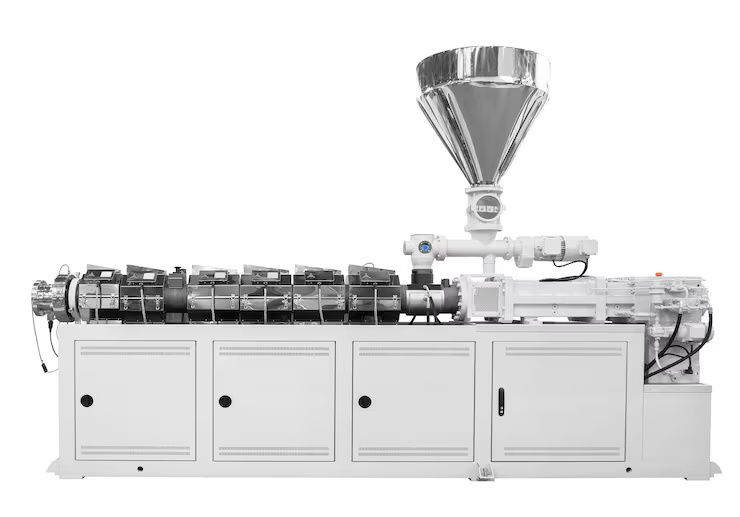
The production process begins with the hopper, where plastic pellets or granules are introduced into the machine. Depending on production requirements, feeding systems may also include material dryers, blending units, or gravimetric feeders that ensure accurate material proportions.
Proper material preparation improves consistency and helps reduce processing variations.
Extruder Barrel and Screw
The screw and barrel form the core of every extrusion machine.
As the screw rotates inside the heated barrel, polymer materials are conveyed, compressed, melted, mixed, and pressurized before reaching the die. Modern screw designs are carefully engineered to provide efficient melting while minimizing material degradation.
Single-screw extruders are widely used for general-purpose production, while twin-screw extruders offer enhanced mixing capabilities for specialized compounds and engineering materials.
Die Assembly
The extrusion die determines the final cross-sectional shape of the product.
Molten polymer flows through precisely engineered channels before exiting the die in the required profile. Die design plays an important role in achieving dimensional accuracy, smooth surface quality, and uniform material distribution.
Different products require different die configurations, making tooling selection a critical aspect of production planning.
The Plastic Extrusion Process
Plastic extrusion follows a continuous sequence of carefully controlled production stages.
Raw polymer enters the hopper and moves into the rotating screw, where external heaters and mechanical friction gradually melt the material. As pressure builds, the molten polymer flows through the extrusion die and emerges with its intended profile.
Immediately after leaving the die, the product enters cooling equipment that stabilizes its dimensions before being pulled through the remaining production line. Depending on the application, products may undergo cutting, winding, printing, or additional finishing operations before packaging.
Maintaining stable operating conditions throughout this sequence is essential for producing consistent products with minimal defects.
Factors That Influence Product Quality
Several processing variables determine the performance and appearance of extruded products.
Temperature control affects polymer viscosity and material flow. Excessive heat may degrade the material, while insufficient heat can produce incomplete melting and poor surface quality.
Screw speed influences output rate, mixing performance, and residence time inside the extruder. Production engineers carefully balance these factors to maintain efficient operation without compromising product quality.
Cooling conditions also play a significant role. Controlled cooling helps preserve dimensional accuracy while reducing internal stresses that may affect long-term product performance.
Regular process monitoring allows operators to identify deviations before they impact production quality.
Applications Across Multiple Industries
Plastic extrusion machines support manufacturing in numerous industrial sectors because of their versatility and continuous production capability.
Typical applications include:
- Water and gas distribution pipes
- Electrical cable insulation
- Flexible and rigid tubing
- Plastic sheets and films
- Window and door profiles
- Medical tubing
- Packaging materials
- Agricultural irrigation products
- Automotive trim components
- Industrial sealing profiles
The ability to produce continuous products with consistent dimensions makes extrusion suitable for both high-volume manufacturing and specialized industrial applications.
Automation in Modern Extrusion Systems
Automation has significantly improved the efficiency and reliability of plastic extrusion operations.
Modern extrusion lines incorporate programmable control systems that regulate temperature zones, screw speed, material feeding, pressure, and line speed simultaneously. Operators can monitor production parameters through digital interfaces that provide real-time performance information.
Advanced systems also integrate sensors capable of measuring melt pressure, product dimensions, and process stability. These technologies help reduce material waste while improving production consistency.
Predictive maintenance and production analytics are becoming increasingly common, allowing manufacturers to optimize machine performance and reduce unplanned downtime.
Maintenance Supports Reliable Production
Consistent maintenance helps plastic extrusion machines deliver stable performance throughout extended production cycles.
Routine maintenance activities typically include screw and barrel inspection, heater verification, lubrication, sensor calibration, die cleaning, and examination of cooling systems. These practices reduce equipment wear while maintaining production quality.
Cleaning material residues after production changes also helps prevent contamination between different polymer grades and colors.
A structured preventive maintenance program contributes to longer equipment life and improved manufacturing efficiency.
Future Developments in Extrusion Technology
Extrusion technology continues advancing alongside broader developments in industrial automation and sustainable manufacturing.
Manufacturers are improving energy efficiency through optimized heating systems, intelligent process control, and advanced screw geometries. Digital monitoring platforms allow production data to support continuous process improvement and quality management.
Growing interest in recycled polymers and bio-based materials has also encouraged the development of extrusion systems capable of processing a wider range of materials while maintaining consistent product quality.
These innovations are expanding the capabilities of extrusion technology across increasingly diverse manufacturing applications.
Conclusion
Plastic extrusion machines remain one of the most important technologies in polymer processing, enabling the continuous production of high-quality plastic products for numerous industries. Their combination of mechanical engineering, material science, and automated process control supports efficient manufacturing while maintaining consistent product performance.
As production requirements continue evolving, extrusion systems will incorporate greater automation, improved process monitoring, and enhanced material compatibility. Understanding the principles behind plastic extrusion provides valuable insight into one of the manufacturing industry's most versatile and widely applied production technologies.

Related Post...

Industrial Optical Quality Inspection Automation: How Automated Defect Detection Works
Updated: October 02, 2026
Read More
Hydraulic vs Electric Crawler Bulldozers: Explore Power Differences
Updated: August 26, 2026
Read More
EPS Recycling Machines and Foam Recycling Systems: Explore Recycling Methods
Updated: September 04, 2026
Read More