Factory Line Manufacturing Automation: Explore Modern Production Systems
Factory line manufacturing automation has changed how modern production environments coordinate machines, materials, workers, and information.
Instead of relying on isolated equipment, automated production systems connect multiple operations so that manufacturing can move through a controlled and repeatable sequence.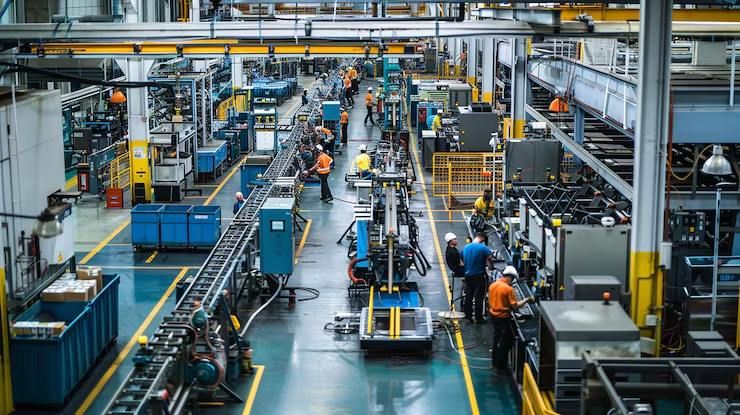
Modern factories use automation for tasks such as material handling, assembly, machining, inspection, packaging, and production monitoring. The objective is not simply to replace manual work. Well-designed automation creates a coordinated production environment where equipment can perform repetitive operations consistently while people focus on supervision, maintenance, engineering, and decision-making.
Understanding how these systems work requires looking beyond individual robots or machines. A factory line depends on control architecture, sensors, industrial communication, material flow, quality checks, and production planning working together. These elements determine how efficiently a manufacturing operation can respond to changing production requirements.
How Modern Factory Lines Are Structured
A modern production line is usually organized as a sequence of connected manufacturing stages. Each station performs a specific operation before transferring the product to the next stage.
The exact configuration depends on the industry. An automotive line may combine robotic welding, painting, assembly, inspection, and material handling, while an electronics facility may rely heavily on automated placement, soldering, testing, and inspection equipment.
Conveyors, robotic transfer systems, automated guided vehicles, and other material-handling technologies move components between operations. Sensors and controllers coordinate these movements so that equipment operates according to defined production logic.
This interconnected structure is what distinguishes an automated production system from a collection of independent machines. A change at one stage can influence downstream operations, making coordination essential.
The Role of Industrial Control Systems
Control systems provide the operational logic behind automated manufacturing. Programmable logic controllers, commonly called PLCs, are widely used to monitor inputs and control industrial equipment.
A PLC can receive information from sensors, process programmed conditions, and activate equipment such as motors, valves, actuators, or robotic systems. For example, a sensor may detect that a component has reached a workstation, allowing the controller to initiate the next operation.
Human-machine interfaces provide another layer of interaction. Operators can use these interfaces to view machine status, adjust permitted parameters, acknowledge alarms, and monitor production conditions.
At larger facilities, supervisory control and data systems can collect information from multiple machines. Manufacturing execution systems can also connect production activities with scheduling, quality, inventory, and operational records.
Sensors Make Automated Decisions Possible
Automation depends heavily on accurate information from the physical production environment. Sensors allow machines to detect position, temperature, pressure, speed, presence, distance, and other operating conditions.
For example, a photoelectric sensor can detect whether an object has reached a specific position. A proximity sensor can identify the presence of a component without physical contact, while temperature sensors can monitor equipment or process conditions.
Machine vision adds another important capability. Cameras and image-processing systems can inspect components for dimensional, surface, assembly, or positioning issues.
The value of these technologies comes from connecting sensing with control. A sensor becomes more useful when the information it produces can trigger an appropriate action or alert.
Robotics and Automated Material Movement
Robots are commonly integrated into factory lines where repetitive, precise, or physically demanding tasks are involved. Industrial robots can perform operations such as welding, machine tending, assembly, palletizing, dispensing, and material transfer.
Collaborative robots, or cobots, provide another approach. They are designed for applications where people and robotic equipment may work in closer proximity, subject to appropriate safety assessment and system design.
Material movement is equally important. Automated guided vehicles and autonomous mobile robots can transport components, work-in-progress, or finished goods between designated areas.
Automation becomes more effective when production equipment and material handling are designed as one system. A highly productive machine can still create a bottleneck if materials do not arrive at the correct workstation at the required time.
Connecting Machines Across the Production Line
Communication between machines is a major part of modern factory automation. Industrial networks allow controllers, sensors, drives, robots, inspection equipment, and software systems to exchange information.
Protocols and technologies such as OPC UA, industrial Ethernet, and field-level communication systems can support data exchange between different components. The specific architecture depends on the equipment, production requirements, and control strategy.
Connectivity also enables centralized monitoring. Instead of checking every machine independently, operators can view operating conditions, alarms, production states, and selected performance information through integrated systems.
However, greater connectivity also increases system complexity. Network architecture, access controls, system segmentation, backups, and cybersecurity practices become important parts of industrial automation planning.
Quality Control Becomes Part of the Process
Modern automation increasingly treats quality inspection as an integrated production activity rather than a separate final check.
Automated inspection systems can evaluate products while they move through the line. Depending on the application, systems may measure dimensions, verify component presence, identify surface defects, confirm assembly positions, or check labels and markings.
When a defect is detected, the production system may automatically reject the affected item or stop a process when a serious condition is identified.
This approach can reduce the likelihood of defective products continuing through multiple downstream stages. It also creates process data that engineers can use to identify recurring problems.
Quality automation does not eliminate the need for human expertise. Engineers and quality teams still need to interpret results, investigate root causes, validate inspection methods, and determine appropriate corrective actions.
Production Data and Real-Time Monitoring
One of the biggest changes in factory automation is the growing role of production data.
Automated equipment can generate information about machine states, cycle times, downtime events, output quantities, alarms, energy consumption, and process conditions. When collected systematically, this information provides a clearer picture of how a production line is performing.
Manufacturers can use dashboards and manufacturing software to identify recurring stoppages or performance losses. Historical information can also help engineers compare production periods and investigate changes in operating behavior.
The usefulness of production data depends on its quality. Collecting thousands of data points does not automatically improve manufacturing. The information must be relevant, reliable, understandable, and connected to decisions that operators and engineers can actually make.
Designing Automation Around the Entire Workflow
Successful automation begins with understanding the complete production process rather than selecting equipment first.
Engineers need to examine material entry, individual processing stages, inspection points, storage locations, operator interaction, maintenance access, and finished-product movement.
Bottlenecks are particularly important. Increasing the speed of one machine may have little effect on overall production if another station has lower capacity.
Line balancing therefore becomes a central engineering consideration. Production stages need to work together at appropriate cycle times while allowing reasonable flexibility for maintenance, changeovers, and variations in demand.
Safety must also be incorporated into the design. Emergency stops, guarding, safety sensors, access controls, safe operating procedures, and risk assessments are important components of an industrial automation system.
Where Human Workers Fit Into Automated Production
Automation changes jobs within a factory, but it does not remove the need for skilled people. Modern production systems still depend on technicians, engineers, operators, quality specialists, maintenance teams, and supervisors.
Workers may increasingly interact with production systems through digital interfaces rather than manually performing every repetitive task.
Maintenance personnel, for example, may use machine diagnostics to identify abnormal conditions before equipment failure occurs. Engineers can analyze production data to improve processes, while operators may supervise several automated stations instead of controlling a single machine manually.
This shift makes technical skills increasingly important. Understanding controls, robotics, mechanical systems, industrial networks, and data interpretation can all contribute to effective factory operations.
Flexibility Is Becoming a Core Design Requirement
Traditional production lines were often designed around long runs of standardized products. Modern manufacturers frequently need greater flexibility because product configurations, batch sizes, and production requirements can change.
Flexible automation may use programmable equipment, modular tooling, robotic systems, quick-change fixtures, and software-controlled production parameters.
The objective is not to make every factory completely autonomous. Instead, the goal is to create production systems that can adapt without requiring extensive physical reconstruction whenever requirements change.
A flexible line can be particularly valuable when manufacturers produce several product variants on shared equipment.
Frequently Asked Questions
What does factory line manufacturing automation include?
It can include automated machinery, robots, conveyors, sensors, PLCs, machine vision, industrial networks, production software, and automated inspection systems. These components work together to coordinate manufacturing activities.
How do PLCs support automated production?
PLCs receive signals from sensors and other devices, process programmed logic, and control connected machinery. They are commonly used to coordinate sequences, safety-related functions, equipment movement, and process operations.
Does factory automation eliminate human workers?
No. Automation changes how people participate in manufacturing. Workers remain essential for engineering, maintenance, quality control, supervision, troubleshooting, programming, and process improvement.
Why is machine vision used in production lines?
Machine vision allows automated systems to inspect products or components using cameras and image-processing techniques. It can help identify defects, verify assembly, check positioning, and measure selected characteristics.
What makes an automated production line flexible?
Programmable equipment, modular tooling, adaptable robots, configurable software, and efficient changeover processes can make a production line more flexible. The appropriate combination depends on the products and manufacturing process.
Conclusion
Factory line manufacturing automation is no longer limited to individual automated machines. Modern production systems combine controls, robotics, sensors, material handling, inspection, industrial communication, and production data into coordinated manufacturing environments.
The strongest automation designs begin with the production workflow itself. By balancing equipment capacity, material movement, quality control, safety, data, and human expertise, manufacturers can create production lines that are more consistent and adaptable. Modern automation is ultimately about building a connected manufacturing process in which machines and people work together with greater visibility and control.

Related Post...
Conveyor Belt Systems Guide: Basics, Types, and Industrial Applications
Updated: October 01, 2026
Read More
Industrial Production Automation Integration: Explore Connected Manufacturing Workflows
Updated: October 01, 2026
Read More
Remote Workforce Infrastructure Explained: Discover Key Details, Facts, and Information
Updated: October 01, 2026
Read More